Rice cooker technology has progressed through several distinct generations. Early models operated on simple thermostats—basic temperature switches that turned heat on and off. Later developments introduced microcomputers that could execute more complex cooking sequences. The progression reflects broader technological evolution: as computers become more sophisticated, they enable more refined control over cooking processes.
The latest category in this progression involves what’s sometimes called “fuzzy logic” or “Neuro Fuzzy” technology. These terms sound technical and somewhat mysterious, which can make the concept seem more complicated than it actually is. In practical terms, Neuro Fuzzy systems use a form of artificial intelligence to learn and adapt based on cooking conditions, rather than simply following a fixed program.
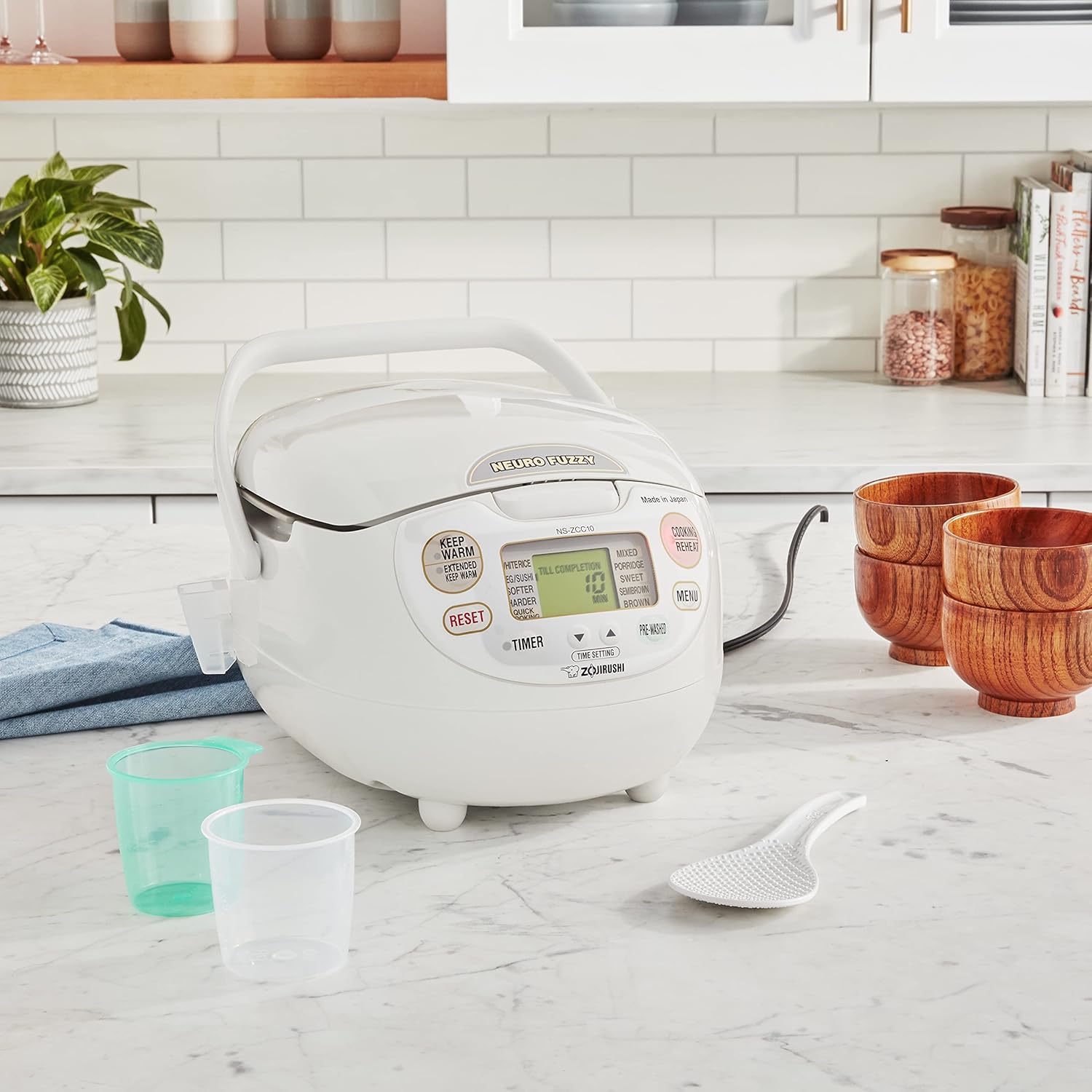
The Zojirushi NS-ZCC10 represents this technology category. A 5.5-cup capacity rice cooker finished in premium white, it operates using Neuro Fuzzy algorithms to manage the cooking process. Understanding what this technology does, how it differs from other approaches, and whether it aligns with your cooking patterns can help you make an informed decision about whether this type of cooker suits your needs.
Understanding Neuro Fuzzy Technology in Rice Cookers
The term “Neuro Fuzzy” combines two technological concepts. “Neural” refers to neural networks, computer systems loosely modeled on how biological brains process information. “Fuzzy” refers to fuzzy logic—a mathematical approach that handles uncertain or approximate information rather than requiring perfectly precise inputs.
In traditional computer systems, logic is binary: something is either true or false, zero or one. Fuzzy logic allows for gradations. Rather than defining something as “done cooking” or “not done cooking,” fuzzy logic can recognize degrees of doneness and adjust heating accordingly.
Applied to rice cooking, Neuro Fuzzy technology means the cooker can learn from each cooking cycle and adjust future cooking based on what happened previously. For example, if the rice turned out slightly mushy one time, the system might reduce heat slightly during the next cooking cycle. If rice was slightly firm, it might increase cooking temperature or duration next time.
This adaptive approach is theoretically more sophisticated than systems that follow a fixed, unchanging cooking program every time. Rather than assuming all water absorbs at the same rate or that all environmental conditions are identical, the Neuro Fuzzy system responds to actual conditions observed during cooking.
In practice, this means potential advantages including more consistent results across different rice batches, better accommodation for variations in rice quality or water composition, and potentially improved texture outcomes compared to simpler systems. The system learns from your water, your rice, and your climate conditions, theoretically optimizing for your specific situation rather than assuming generic cooking parameters.
Key Features of the NS-ZCC10
Capacity and Exterior Design
The 5.5-cup capacity (measuring uncooked rice) matches standard household sizes of approximately 4-6 people eating rice as a regular meal component. The premium white exterior finish provides a contemporary appearance that coordinates with many modern kitchen designs. Unlike darker finishes that can show dust and fingerprints, white exteriors tend to hide minor soiling, though they may show stains more readily.
The physical dimensions of a 5.5-cup cooker make it suitable for most standard kitchen countertops without occupying excessive space. It’s larger than very basic compact cookers but more manageable than commercial or institutional models. The overall design prioritizes function over decorative elements, presenting a clean, minimalist appearance.
Neuro Fuzzy Artificial Intelligence System
The core distinguishing feature is the Neuro Fuzzy control system. Rather than executing a predetermined cooking sequence that’s identical every time, this system monitors cooking conditions and adjusts heating throughout the process. Sensors detect changes in temperature, steam production, and other indicators of how cooking is progressing.
The neural network component learns from patterns across multiple cooking cycles. The fuzzy logic component allows the system to make decisions based on fuzzy concepts like “slightly faster water absorption than normal” rather than requiring absolute certainty about specific conditions.
In practical application, this means the system can adjust cooking parameters based on factors that vary unpredictably: rice moisture content varies between batches and suppliers, water mineral content differs by region, room temperature fluctuates seasonally, and altitude affects water boiling points. Rather than hoping a fixed program accommodates these variables, the Neuro Fuzzy system responds to what’s actually happening.
Multiple Cooking Programs
Despite the sophisticated technology, the control interface remains relatively straightforward. Various cooking programs allow you to select settings for white rice, brown rice, and potentially other options depending on the specific model variation. Each program represents a different starting point for the Neuro Fuzzy algorithm—the system learns and adjusts based on that initial program selection.
A white rice program initiates with cooking parameters optimized for short-grain white rice. A brown rice program starts with parameters suited to brown rice’s different characteristics. The Neuro Fuzzy system then adjusts from those starting points based on what sensors detect during cooking.
Cooking Capacity Variety
While primarily designed for rice cooking, many rice cookers in this category can prepare other foods. The instruction manual specifies available functions, which might include settings for cooking congee (rice porridge), steaming vegetables using an elevated tray, or cooking other grains. Not all Zojirushi Neuro Fuzzy models have identical additional functions, so consulting your specific model’s manual is important.
Keep-Warm Function
After cooking completes, the cooker automatically switches to keep-warm mode, maintaining rice at safe serving temperature. This function typically operates for several hours without significant quality degradation. The keep-warm cycle uses minimal energy compared to active cooking.
Interface and Display
A digital display shows current status and often estimated time remaining. The control buttons select cooking programs and initiate the cooking cycle. This simplicity is intentional—the sophisticated technology operates in the background while you interact with straightforward controls.
How the NS-ZCC10 Operates in Practice
Loading and Cooking Rice
Using a Neuro Fuzzy rice cooker follows the same basic steps as other rice cookers: measure uncooked rice using the included cup, rinse if desired, add to the inner pot, add appropriate water, close the lid, select a program, and press cook.
The difference between this and simpler cookers emerges once cooking begins. While a basic cooker heats at one temperature until water is absorbed, then switches to warming, the Neuro Fuzzy system is continuously monitoring and adjusting. Heating might vary subtly as the system detects water absorption rates, adjusts for moisture levels, or responds to temperature fluctuations.
The visible result is that rice quality tends to be more consistent batch-to-batch. Rather than sometimes turning out slightly mushy and other times slightly firm, the Neuro Fuzzy learning adjusts heating to find an optimal balance for your specific conditions.
Learning and Adaptation Over Time
The learning aspect occurs gradually across multiple cooking cycles. The first time you cook rice, the system begins establishing a baseline. After several cooking cycles, the system has gathered data about how rice cooks in your water, with your rice type, at your altitude and climate conditions. Adjustments become more refined as the system learns.
This means that initial cooking results might be good, but results improve with repeated use. After several weeks of regular rice cooking, you might notice the cooker consistently producing exactly your preferred texture. This gradual improvement represents the system learning your specific situation.
Cooking Different Rice Varieties
Different rice types have different cooking requirements. The Neuro Fuzzy system can manage these differences, though selecting the appropriate initial program helps. A brown rice program starts the learning process with parameters appropriate for brown rice. The system then learns and adjusts based on your specific brown rice and conditions.
Short-grain rice absorbs water quickly and cooks in 20-30 minutes. Long-grain rice takes longer because water absorption is slower. Brown rice requires substantially more time and water because the tough outer hull requires extended cooking to soften.
By selecting the appropriate program, you give the Neuro Fuzzy system a good starting point. The system then fine-tunes from there based on what it observes during cooking.
Extended Cooking Capabilities
Beyond basic rice cooking, many users find additional applications. Congee or porridge cooking uses the same cooker with much higher water-to-rice ratios. Steaming accessories allow cooking vegetables or dumplings above the rice. Some people use the cooker to simply heat water for tea or instant noodles.
These extended uses depend on available functions in your specific model. Always consult the instruction manual before attempting cooking applications beyond standard rice preparation.
Who Might Find This Cooker Suitable
Home Cooks Prioritizing Consistency
If you eat rice regularly and want results to be consistently excellent without much thought or adjustment, Neuro Fuzzy technology appeals directly to you. The learning system handles variations automatically, working behind the scenes to optimize cooking for your situation.
People Transitioning to Regular Rice Cooking
If you’re accustomed to stovetop rice cooking and want to incorporate rice more frequently into your diet, a Neuro Fuzzy cooker removes the technical complexity while delivering reliable results. The system learns your preferences and accommodates your local water and climate conditions automatically.
Those with Hard or Unusual Water
Water composition varies significantly by geography. Some regions have very hard water with high mineral content. Others have soft water. Some locations have particularly high or low pH. These variations affect rice cooking in subtle ways. A Neuro Fuzzy system learns to accommodate your specific water conditions, adjusting heating and timing as needed. This is a genuine advantage over fixed-program cookers.
Households at Different Altitudes
Altitude affects water boiling points and cooking times. At sea level, water boils at 100°C (212°F). At 5,000 feet elevation, water boils at approximately 95°C (202°F). At 10,000 feet, it’s around 90°C (194°F). These differences affect cooking times significantly. A Neuro Fuzzy system accommodates altitude variations by learning and adjusting heating times accordingly.
People Who Want “Set and Forget” Cooking
The primary appeal of rice cookers is convenience: load with rice and water, press a button, and return to finished rice. Neuro Fuzzy systems enhance this convenience by learning your preferences and conditions, essentially making the cooker more intelligent about optimizing results specific to your situation.
Home Cooks in Variable Climates
Seasonal temperature changes affect how rice cooks. Summer cooking in air-conditioned kitchens is different from winter cooking in ambient temperature. A Neuro Fuzzy system continuously learns and adjusts to these seasonal variations.
Important Considerations Before Purchasing
Understanding What Neuro Fuzzy Actually Does
While Neuro Fuzzy technology is genuinely more sophisticated than fixed-program systems, it’s important to have realistic expectations. It produces reliably good rice with consistent texture—but it won’t transform basic rice into something extraordinary. The practical differences between Neuro Fuzzy results and results from well-designed Micom systems might be subtle. Neuro Fuzzy is an optimization, not a revolutionary change.
Capacity Alignment with Actual Needs
The 5.5-cup capacity serves most household sizes adequately. Before purchasing, calculate how many people regularly eat rice at your table and how often. If rice appears in meals multiple times weekly, this capacity is practical. If you cook rice monthly or less frequently, having a dedicated cooker might not make sense regardless of sophistication.
Learning Period Expectations
The system learns gradually across multiple cooking cycles. You shouldn’t expect dramatically different results immediately. Instead, expect gradual improvements as the system gathers data. This learning period might take several weeks of regular cooking. If you cook rice infrequently, the learning advantage diminishes because the system has less data to learn from.
Maintenance and Longevity
Regular cleaning maintains proper function. The inner pot should be washed after each use. Allowing rice residue to harden inside can damage the non-stick coating and interfere with sensors. The cooker should function reliably for years with proper care, though no appliance is guaranteed indefinitely.
Warranty and Support Structure
Zojirushi products include manufacturer warranties, though specific coverage varies by region and purchase location. Understanding warranty scope, coverage duration, and claim procedures is important. Some regions have better parts availability and support than others.
Interface Learning
While the controls are relatively simple, spending time with the instruction manual before first use ensures you understand all available functions and any special procedures (such as delayed start cooking or cleaning recommendations). Understanding the system prevents confusion and helps you use all available features effectively.
How Neuro Fuzzy Cookers Compare to Other Technologies
Versus Basic Thermostatic Cookers
Entry-level cookers use simple thermostat switches with no learning capability. They’re substantially less expensive and work adequately for casual rice cooking. The trade-off is consistency—results vary more based on rice quality, water composition, and conditions. For people unconcerned with optimized texture, basic cookers accomplish the task.
Versus Micom Cookers
Micom (microcomputer) systems execute sophisticated but predetermined cooking programs. They adjust heating based on a fixed sequence but don’t learn or adapt across cooking cycles. Micom cookers typically cost less than Neuro Fuzzy models and still produce excellent, consistent rice. The difference between Micom and Neuro Fuzzy results is often subtle—Neuro Fuzzy offers slight additional optimization, but Micom delivers very good results as-is.
Versus Induction Heating Cookers
Induction heating uses electromagnetic energy to heat the cooking pot directly, allowing very precise temperature control. These cookers often cook faster than other technologies. Induction heating tends to be more expensive than both Micom and Neuro Fuzzy systems. The practical cooking results between induction and Neuro Fuzzy systems are typically comparable, with differences coming down to specific preferences and circumstances.
Versus Pressure Cookers
Pressure cookers cook rice dramatically faster, sometimes in under 10 minutes. They require more technique and carry a steeper learning curve. Many people find them intimidating. Conventional rice cookers (including Neuro Fuzzy models) are slower but more forgiving and easier to use.
Versus Stovetop Cooking
Stovetop cooking gives you maximum control but requires active attention throughout the process. You must watch for boiling, adjust heat, and judge when cooking is complete. The convenience and reliability advantages of any rice cooker—Neuro Fuzzy or otherwise—over stovetop cooking are substantial.
Frequently Asked Questions
Q: How long does the Neuro Fuzzy learning process take?
A: The system begins adapting from your first cooking cycle, but noticeable improvements typically develop across several weeks of regular cooking. If you cook rice once or twice weekly, observable optimization might take 4-8 weeks. The learning is gradual and continuous—the system keeps refining adjustments even after months of use.
Q: Will Neuro Fuzzy produce noticeably different results than a Micom cooker?
A: Both systems produce excellent, consistent rice. The difference is often subtle rather than dramatic. Neuro Fuzzy offers additional optimization through learning and adaptation, but if you already achieve great results with a Micom cooker, the improvement might be barely perceptible. Neuro Fuzzy is particularly valuable if you have unusual water conditions, high altitude, or very specific texture preferences.
Q: Can I use this cooker with different water sources?
A: Yes, though the Neuro Fuzzy system will need to readjust when you switch water sources. If you normally use tap water but occasionally use filtered water, the system will notice the difference and adjust. This adaptive capability is one of Neuro Fuzzy’s advantages—it accommodates variations rather than assuming every cooking condition is identical.
Q: Does Neuro Fuzzy technology require special maintenance?
A: No—maintenance is the same as any other rice cooker. Regular cleaning of the inner pot and occasional exterior wiping maintains proper function. The sensors are internal and don’t require special care.
Q: What happens if I cook with a different rice brand?
A: The Neuro Fuzzy system will initially cook using the program you selected (white rice, brown rice, etc.), then adjust based on how this particular rice cooks. Brands vary in starch content, moisture, and grain size, affecting water absorption. The system learns and accommodates these differences, gradually optimizing results for the rice you actually cook with most frequently.
Q: How long does rice stay at serving temperature in keep-warm mode?
A: The keep-warm function typically maintains safe serving temperature for 4-8 hours. Extended periods beyond this can degrade rice quality as it gradually dries out. For optimal quality, consume rice within a few hours of cooking completing.
Q: Can I cook brown rice in the white rice program?
A: Not optimally. Brown rice requires more water and longer cooking time. Using the white rice program would likely result in undercooked brown rice. Using the brown rice program starts the Neuro Fuzzy system with appropriate parameters for brown rice, allowing it to then learn and adjust for your specific situation. Always select the program matching your rice type.
Q: Is the inner pot dishwasher-safe?
A: Most Zojirushi inner pots are hand-wash only to preserve the non-stick coating. Dishwasher temperatures and detergents can damage the surface. Check your specific model’s manual for cleaning instructions. Hand-washing is quick and helps ensure longevity.
Q: What if my cooker produces consistently mushy rice?
A: First, verify you’re using the correct water-to-rice ratio for your specific rice type. Different varieties require different water amounts. The instruction manual provides these ratios. If using correct ratios and results are still too soft, the Neuro Fuzzy system is likely adjusting for what it perceives as too-firm results from previous cycles. Using the cooker over additional weeks allows it to learn your preferences and optimize appropriately. Alternatively, you can reference the manual for any adjustments to initial program parameters.
Q: How much space does this cooker require on a counter?
A: A 5.5-cup rice cooker is relatively compact—approximately 10-12 inches wide and 9-10 inches deep (dimensions vary slightly by model). It fits comfortably on most kitchen counters without occupying excessive space. Measure your available counter space before purchasing if space is limited.
Q: Can I cook other grains in this cooker?
A: Depending on your specific model, you might be able to cook grains like barley, quinoa, or oats. The instruction manual specifies what grains are supported and appropriate water ratios. Some experimentation might be necessary as the Neuro Fuzzy system learns how different grains cook. Starting with small test batches before cooking full quantities is wise.
Conclusion
The Zojirushi NS-ZCC10 Neuro Fuzzy rice cooker represents rice cooking technology at a sophisticated level. Rather than executing a single predetermined cooking program, it learns and adapts based on actual cooking conditions, continuously optimizing results for your specific situation—your water, your rice, your climate, your altitude.
This learning capability is particularly valuable if you cook rice frequently, have unusual water conditions, cook at significant altitude, or have very specific texture preferences. The system handles these variables automatically rather than requiring manual adjustments or hoping that a fixed program accommodates variations.
The practical advantage is rice that’s consistent and optimized for your circumstances. Over weeks and months of regular use, the cooker becomes increasingly attuned to producing exactly your preferred texture. This gradual improvement is the primary benefit distinguishing Neuro Fuzzy systems from simpler approaches.
Whether this technology justifies its cost relative to Micom or basic cookers depends on your situation. If rice is a regular dietary staple and you value consistency, Neuro Fuzzy offers genuine advantages. If you cook rice occasionally or are satisfied with results from simpler systems, the extra sophistication might not provide meaningful benefit.
Evaluating your actual rice consumption patterns, understanding realistic expectations about the learning process, and considering your specific local conditions—water quality, altitude, seasonal variations—helps determine whether Neuro Fuzzy technology aligns with your cooking habits and preferences.